
Real Estate Investment in Nigeria: The Ultimate Guide for Beginners
Learn about real estate investment, its benefits, investment strategies, property types, steps to start investing, and risks.
Valentine Okoye
1/12/202610 min read
Home > Real Estate Investment > Real Estate Investment in Nigeria: The Ultimate Guide for Beginners

If you're new to real estate investment or you've been investing for a while, this guide has everything you need to find your way around the market.
Here’s an outline of what the guide covers:
What is real estate?
What is real estate investment?
Why invest in real estate?
Real estate investment strategies
The major property types
How to get started with real estate investing as a beginner
Risks and mitigation strategies
What is real estate?
Real estate is basically land and anything permanently attached to it. Examples are buildings, fences, bridges, trees, and even water.
The word “real” in "real estate" means property or land. It emphasises that the property is tied to the land and immovable. That is, it’s landed property, and you can't move it around like personal property, like cars or furniture.
Real estate can be broken down into two main components:
Land: This is the earth's surface down to the centre of the earth and up to the skies, including everything permanently attached by nature, such as water, trees, and minerals.
Improvements: These are artificial additions to the land, such as buildings, roads, and utilities.
What is real estate investment?
Real estate investment (realty investment) is one of the most trusted ways to build long-term wealth. It simply means buying, owning, managing, renting out, or selling properties, such as houses, shops, or factories, to generate income.
It's a part of the financial market that deals with different kinds of properties, such as:
Residential or homes like bungalows, flats
Commercial or business places like office buildings, shops, malls
Industrial spaces like warehouses, factories
Special properties like churches, schools, hospitals, burial grounds
And even just land.
People usually invest in real estate to make money in two ways:
Rental payments: By collecting rent from tenants
Appreciation in property value over time: By buying property at a low price and selling it for more later on.
See: How to make money from investing in real estate.
Why invest in real estate?
Real estate is a unique asset with advantages over traditional assets, such as stocks (company shares) or government bonds.
Here’s why you should invest in real estate:
1. Passive income
As a real estate investor, you can make money without lifting a finger. This is passive income through rent payments.
And you don’t even have to be a landlord who fixes things and deals with tenants. All you have to do is invest your money, and professionals will handle the rest for you.
For example, you might put your money into something called a real estate investment trust (REIT) or a crowdfunding platform, and you get paid some money monthly from rent or profits.
This money keeps coming in as long as your investment is doing well. You don’t have to work for it. Just choose a smart investment option and check in once in a while.
2. Value appreciation
Value appreciation is when your property increases in value as time goes by.
So, if you buy a property and later it's worth more than what you paid, that's called appreciation or a capital gain.
This mostly happens because the neighbourhood gets nicer, the economy grows, or there are improvements within the location (e.g., new roads, schools). Sometimes, you can speed up appreciation by fixing up or upgrading your property.
This then allows you to sell your property for more than you initially paid for it. The extra money you get from the sale is your profit from appreciation.
3. Inflation hedge
An inflation hedge means that owning property can help protect your money from losing value when prices everywhere go up. Inflation is when the cost of items (e.g., food, clothes, or gas) keeps rising and makes each kobo worth less over time.
However, when you invest in real estate, both the value of your property and the rent you can charge usually go up as inflation rises. This helps keep your money's value more stable because your investment grows along with prices.
So, investing in real estate gives you a better shot at keeping up with rising costs compared to leaving money in the bank.
Real estate is a fixed factor of production, while population continuously increases in a geometric progression. This means that the demand for land and buildings will always be greater than the supply.
4. Leverage
Leverage is when you use borrowed money, like a mortgage, to buy a property instead of paying the full price with your own cash. This lets you buy a much bigger property or even several properties with less of your own money upfront.
If the property goes up in value or you make money from rent, you get to keep the profits after you pay back the bank or lender.
This can help you grow your wealth faster.
5. Tax advantages
The concept of tax advantages (or tax benefits) in real estate investing means the government can give you special breaks that help you pay less tax and keep more of your money when you own property.
For example, you can often subtract (or write off) things like repairs, property taxes, and loan interest from your real estate income. This subtraction or deduction means you’ll pay less tax.
Another big advantage is something called depreciation. This lets you claim that your property loses value every year (even if it's actually getting more valuable). That way, you pay even less in taxes.
Subscribe to our newsletter
Real estate investment strategies
There are two main approaches to real estate investment. They include:
Direct ownership (active)
And indirect investment (passive).
The approach you choose depends on your capital, the level of risk you’re willing to take, and the degree of involvement you desire in the investment.
Let’s discuss them below:
I. Direct ownership (active)
Direct ownership or active real estate investment means you own the property, manage it, and keep the profits.
Examples of direct ownership or active real estate investment include:
Buying and holding (rental property)
Property flipping (fix and flip)
Wholesaling
BRRRR Method.
1. Buying and Holding (rental property)
This means purchasing or building a property (residential or commercial) and renting it out long-term for cash flow and appreciation.
It is best for you if:
You want to build long-term wealth.
You seek passive income.
You’re comfortable being a landlord or hiring a property manager.
2. Property flipping (fix and flip)
This means buying an undervalued property (land or building), renovating it quickly to increase its value, and selling it for a short-term profit.
It’s best for you if you have the following:
Construction/renovation skills
Access to capital
And a desire for short-term, high returns.
3. Wholesaling
Wholesaling involves finding undervalued properties and quickly selling them to another buyer (often a flipper) to make a profit, without ever actually owning the property yourself.
It is best for you if you’re a beginning investor with strong networking/sales skills and limited capital.
This strategy is best for you if:
You’re new to real estate investing and want to start with minimal capital.
You want to make quick profits without long-term property ownership.
You have a strong network of buyers and sellers.
You’re skilled at finding undervalued properties.
4. BRRRR method
BRRRR stands for Buy, Rehab, Rent, Refinance, Repeat.
Here’s how it works:
You buy an undervalued property selling for less than it is worth.
You renovate it to boost its value.
You rent it out to tenants to start making some money.
You refinance the property based on its new, higher value.
You pull out your initial capital to go for your next project.
This strategy requires significant time, effort, and resources, so it’s not for everyone.
It’s best for you if:
You have some experience in real estate investing and renovation.
You’re willing and able to put in the time and effort to rehabilitate properties.
You’re patient and willing to hold onto properties for rental income.
II. Indirect investment (passive)
Indirect or passive real estate investment allows you to invest in real estate with limited capital and without the headaches of directly managing properties.
Examples of indirect investment include:
Real estate investment trusts (REITs)
Real estate crowdfunding
Real estate investment groups (REIGs)
1. Real estate investment trusts (REITs)
A REIT is a company that owns or finances properties.
In this indirect investment strategy,
You put your money into a REIT.
The REIT earns rental income from its properties (e.g., office buildings, apartments, or shopping centres).
You get a share of the income earned by the properties, usually in the form of dividends.
This is best for passive investors. The advantages include:
The entry barrier is low.
The company must pay at least 90% of its profits to investors as dividends.
You can sell or withdraw your money quickly.
2. Real estate crowdfunding
This has to do with online platforms that pool people’s money together to fund a real estate project or property.
This strategy is best for you if:
You don't have enough money to buy a whole property.
You’re new to real estate investing and want to start small.
You want to spread your investments across different asset classes.
3. Real estate investment groups (REIGs)
These are companies that allow a group of people (investors) to put their money together to buy properties. Then the companies manage the properties and distribute rental income to investors.
Think of REIGs as a form of mutual funds for rental properties.
This strategy is best for you if:
You want to invest in real estate without dealing with tenants/maintenance.
You’re new to real estate investing and want professional management.
See: real estate investment opportunities.
The major property types
The major property types include:
Residential
Commercial
Land.
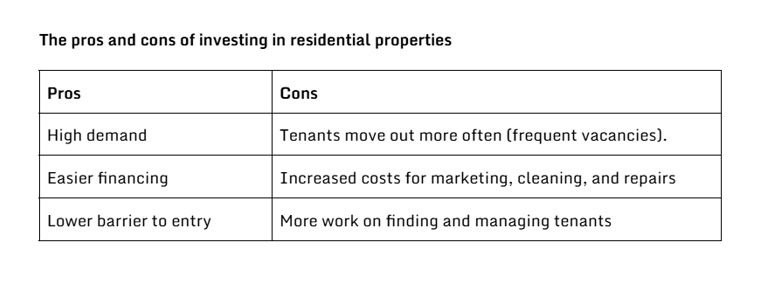
I. Residential
The focus of residential properties is on:
Single-family homes
And multi-family (duplexes, apartments) homes.
The income source is tenant rent.
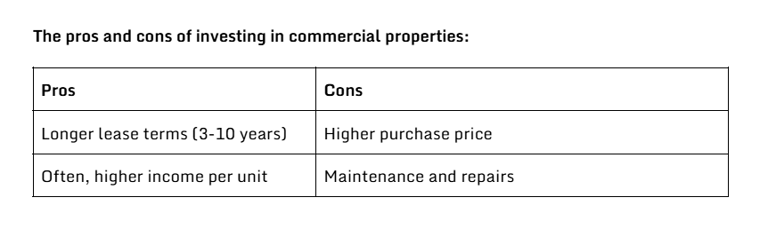
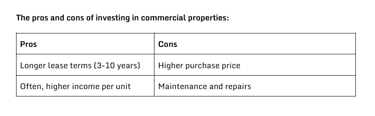
II. Commercial
The focus of commercial properties is on:
Office buildings
Retail stores
Industrial warehouses.
The income source is business leases.
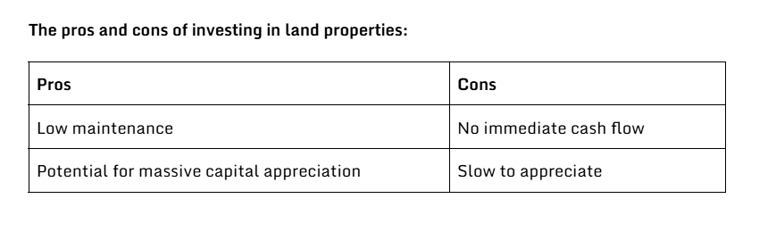
III. Land
The focus of land is on:
Raw land
Development parcels
Agricultural land.
The income source includes leases or eventual sales.
Subscribe to our newsletter
How to get started with real estate investing as a beginner
Starting your real estate investment journey requires careful planning and research.
Here's a step-by-step guide to get started with real estate investing as a beginner:
1. Set clear goals.
Define what you want to achieve through real estate investing, such as:
Rental income (cash flow): This means generating a consistent stream of income from leasing out your properties to tenants.
Long-term appreciation: This involves holding your properties for several years while anticipating that market forces, economic growth, and property improvements will increase their value.
Short-term profits (flipping/wholesaling): This entails generating returns through the quick buying and reselling of properties.
When you set clear goals, you can choose suitable property types and create a strong investment plan that will help you achieve them.
2. Educate yourself.
Real estate offers a range of investment opportunities, each with its own unique features, risks, and potential returns.
So, learn about different types of real estate investments, such as:
Rental properties
Flipping
Or REITs.
Understanding them will help you make informed decisions that align with your financial goals and risk tolerance.
And since you’re here, you’re already learning.
3. Assess your finances.
Before making any investment decisions, conduct a thorough financial assessment. This involves evaluating the following:
Income: Understand your total monthly or annual income from all sources (e.g., salary, wages, freelance income).
Expenses: Track all your expenses, including fixed expenses (e.g., rent, loan payments) and variable expenses (e.g., food items, transportation).
Debts: Analyse your current debt obligations, including student loans and rent.
Assessing your finances helps you know how much you can realistically afford to invest in real estate.
4. Choose an investment strategy.
Choose a strategy that aligns with your financial goals. Examples of strategies include:
Buying and holding
Fixing and flipping
Wholesaling.
Each strategy has its own set of risks, rewards, and operational demands. So, when choosing a strategy, consider your:
Financial resources
How much risk you can tolerate or take
How much time you can commit to property research.
5. Build a team.
To ensure a smooth and legally compliant real estate transaction, get a dedicated team of professionals. Your team should ideally include:
Real estate agent to guide you through market conditions, property searches, negotiations, and the complexities of offers and counter-offers.
Lawyer to review legal documents (e.g., purchase agreements, title reports, and disclosure statements) and ensure legal compliance
Accountant to advise you on the financial implications of your real estate transactions.
6. Get financing.
To effectively fund your investment, explore a range of financing options. They include:
Mortgages: A mortgage is a type of loan secured by real estate. It's a common option for property-related investments.
Loans: A loan is a broader category of debt financing beyond just real estate. It can be secured (with collateral) or unsecured (without collateral).
Partnerships: This means collaborating with others, pooling capital, expertise, or resources for shared investment profits/ownership.
Now, the best option depends on the nature of your investment, your risk tolerance, and your creditworthiness.
7. Start small.
Begin with a single property or a small investment to gain experience and build momentum.
Starting small allows you to develop a stronger foundation of knowledge and confidence. With these, you can expand your investment portfolio and pursue more ambitious opportunities.
Subscribe to our newsletter
Risks and mitigation strategies
While lucrative, real estate investment has its risks. So, being prepared is key to long-term success.
The risks include:
Vacancy risk
Market risk
Liquidity risk
Unexpected costs
Financial/Leverage risk
1. Vacancy/Occupancy risk
This risk has to do with periods when your property has no tenant, resulting in zero income.
To mitigate this risk,
Thoroughly screen tenants
Use competitive pricing for your property
Maintain an emergency reserve fund (3-6 months).
2. Market risk
This entails economic downturns, high interest rates, or oversupply in a local market that decreases property values or rent.
The mitigation strategies include:
Diversifying geographically
Investing in areas with strong job/population growth
Adopting a long-term holding period.
3. Liquidity risk
Real estate is illiquid. That means you can’t quickly convert your properties to cash without a major loss.
To mitigate this risk:
Only invest capital you won't need immediately.
Have a clear exit strategy (selling or refinancing).
4. Unexpected costs
This means sudden, large expenses (e.g., new roof, major flood damage).
Mitigation strategies include:
Conducting a thorough property inspection before buying
Factoring in a maintenance reserve (1-2% of property value annually)
Securing comprehensive insurance.
5. Financial/Leverage risk
This means over-leveraging or borrowing too much money against your property. This can lead to unmanageable debt if income decreases.
To mitigate this risk:
Avoid too much debt compared to your own money.
Choose fixed-rate mortgages to prevent interest rate increases.
Bottom line
This guide provides a comprehensive overview of real estate investment, covering strategies, property types, and a beginner's guide to getting started. It also addresses risks and offers mitigation strategies for long-term success.